
Leaning into mystery
With encouragement from a huge flock of black cockatoos

I’ve just had to move out of my house (the dynamics that led up to this necessary action have been playing out for years, something Jessica Böhme and I get into in our most recently published episode of Philosophy & Organisations).
In my attempt to say goodbye, give thanks, and open to new possibilities, I began walking around the park my house backed onto (before a little ritual in the house and on the shared rooftop). The park has been a very special place for me, my parter, my daughter and our incredible little canine family member.
About half way around my first lap, a flock of approximately 60 black cockatoos flew over me. I’ve never experienced anything like this before. In fact, living in the inner-city, you’d be hard pressed to see one a year.
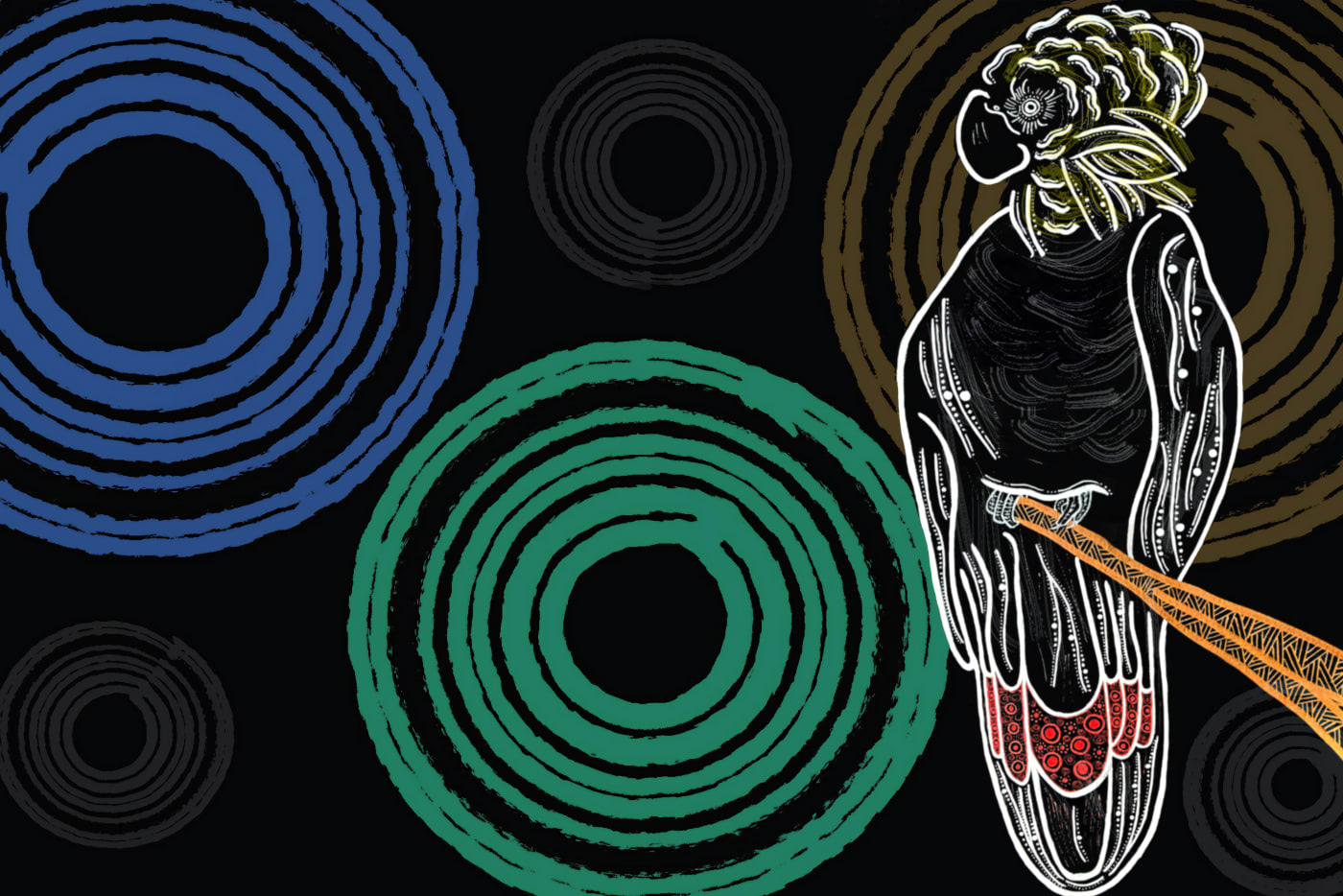
As they flew over me, without knowing their symbolic meaning/s to different groups of First Nations Australians, I intuited something special about the experience. Tears began to surface. I didn’t pull my phone out. I just observed their flight. I felt the significance of the (actual) occasion.
This seemed to spark a series of interesting events. The specifics of which aren’t important right now, especially given the fact I’m not making a claim about causality (itself a rather dubious concept). That is not the point of this short musing today, something that will hopefully become evident shortly…
But, later in the day, after all rituals had reached their completion, I engaged in a little search to better understand what this might represent.
And, what I found pretty much summed up what I had felt.
As alluded to in the note above, I am not here to make specific metaphysical claims / attempt to convince you of some specific set of propositional beliefs. In fact, I’m not even doing that myself in relation to this experience.
What I would like to do is use this example—the experience I had today—as a way to encourage greater openness to mystery, a deeper appreciation of beauty, and a more reverent relation to the rather wonderful ‘magic’ of existence.
By magic I’m being fairly colloquial for the sake of simplicity, and mean something like that which cannot be fully explained, perhaps now or ever, yet also requires no explanation in order to be satisfying, moving and / or meaningful. This isn’t necessarily a direct comparison of Crowley’s take on ‘magick’, which is the “science and art of causing change to occur in conformity with will”. If I were to really get into it, it’s probably closer to Layman Pascal’s take on ‘xagick’. Yet, and this might be important, it isn’t necessarily equal to a more historical take on magic that could be equated to a form of naiveté, ignorance etc. But again, those details don’t matter too much for today. Let’s steer clear of definitions and go with this flow together.
As I write this encouragement, the following quote feels rather fitting (as a way to help situate the context within which I’m personally approaching the increasingly en vogue topic of mysticism):
“The way to true mysticism leads up through rational thought to deep experience of the world … . We must all venture once more to be ‘thinkers,’ so as to reach mysticism, which is the only direct and the only profound world-view.” - Albert Schweitzer, Civilization and Ethics, 1923
What Schweitzer describes maps to my experience.
My ‘openness to mystery’ has emerged over many years and through varying modes of inquiry. It may well have been with me in early life (meaning this is somewhat of a return / remembering, albeit a very different expression, with levels of complexification entirely unimaginable earlier in life), but this sense of the mysterious (again, that I likely revered, at least implicitly, early in life) eventually became an obsession with (certain types of) explanation, justification, mechanisms of action, and all manner of other things (attempting to explain / justify why isn’t important for now.).
What I mean by openness to mystery, however, unlike the ‘definition’ of magic, is important (today). I’m not encouraging entirely wild metaphysical speculation (I’m also not discouraging it. Important to note here, even though there’s sometimes confusion on this point, that metaphysics isn’t equal to wild speculation. Not even close. It’s an attempt to ‘go beyond’ that which can perhaps be suitably explained by other means. But of course, there is no science free of metaphysics or philosophy more generally. There is no science free of observers or the historicity to which it / they belongs. It’s just that most of the ‘deeper assumptions’ or ‘positions’ underlying the scientific process, its institutions etc. are all too infrequently explicated. This deserves much more than I can give it, so leaving for now). Rather I mean something a tad more practical. I’m encouraging, as I’ve been attempting to practice myself now for quite some time, a deeper sense of awe and wonder (including a wonder with / of ‘situatedness’ i.e. the broader context within which you experience said phenomena), something that we can experience everyday… Something that enhances our experience of what seems likely to be one very finite life.
For instance, imagine if my relation to the huge flock of black cockatoos today went something like this:
Hmmmm, an unusually large flock of black cockatoos
That’s odd. They’re endangered. I wonder why there’s so many of them?
Perhaps they’re fleeing from their home
Someone, somewhere, might be cutting down a bunch of trees and further eroding their local ecology
Fuck! Doesn’t that suck!
Continue walking
No awe. No wonder. Non reverence.
Of course, I’m being a tad facetious. The dot points could well be a plausible(ish) practical explanation (the details of which, if they were in fact true, would be deeply important and not something I’d ever shy away from. Especially given this is happening EVERYWHERE, basically all the time. Again, this isn’t the point for now), but the experience I had would have meant nothing. It wouldn’t have emoted me. It wouldn’t have moved me (largely because I would have been focusing only on the propositional, and entirely missing the perspectival and participatory. See reference below to video on ways of knowing for more).
By simply being with the experience, and allowing myself to really feel, I was literally moved to tears. It felt, whether true in a propositional sense or not, like something important was happening, and that I had participated in that in some small way.
Now, for the ‘rationalists’ amongst you, please don’t take offence. I am not saying that our attempt to explain certain phenomena through certain means is unimportant or unhelpful (if you are taking offence, I’d encourage you to watch this on ways of knowing. It’ll likely satisfy your desire for explanation and justification, but also encourage a bit less binary emphasis on propositional knowledge). What I’m getting at here—to again reiterate my core and very condensed point—is that our everyday experience of life is very likely enhanced when we embrace awe and mystery (and guess what? We have lots of empirical evidence to strongly support such an assertion). Our everyday, and thus our overall life, is likely to be enhanced when we cultivate reverence for our lived experience, as well as for the world within, and because of which, we exist / belong.
So with that, I’d love to know whether you have an example from your own life like this? When did you really feel embedded in your context, without the need to explain propositionally, where the experience moved you deeply? Did you attempt to derive specific meaning from the experience? Or was the experience itself plenty of enough-ness?
Building from this, how do you balance such an appreciation for what is occurring, with the usefulness of certain explanatory and justificatory methods?
Share away. I’m all ears.
With love as always.
As a scientist who also cherishes wonder, I love how you frame mystery not as anti reason but as its complement.
Many of the biggest scientists had a mystery or mythological side to their works too. Biggest example Newton.
You had me at “flock of 60 black cockatoos,” and by the time you invoked Schweitzer and Layman Pascal, I was weeping into my kombucha.
This is how mystery speaks—not through thunderclaps or theological footnotes, but through feathers, tears, and the irreducible weirdness of being alive on a Thursday. The rationalist wants to graph the migration. The mystic just bows and says, “Thank you.”
Your reflection is a gentle slap to the prefrontal cortex. A reminder that participation is knowledge. That presence is the point. That sometimes, not knowing is the holiest form of knowing.
Thank you for honoring the cockatoos, the rooftop, the ache, and the awe.
With holy bewilderment,